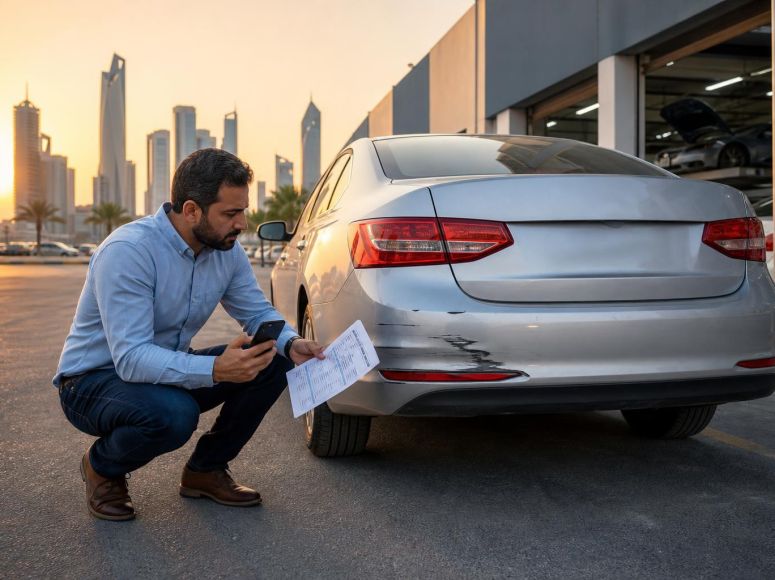
A scraped bumper, cracked mirror or dented door can create a deceptively expensive decision: should you file an insurance claim, or pay for the repair yourself? The right answer depends on more than the workshop quote. Your policy excess, any no-claims benefit, repair conditions and local accident-reporting requirements can all change the true cost.
For drivers across Egypt, the GCC and other MENA markets, this is especially relevant in busy car parks, dense city traffic and on roads where loose debris or sand can cause minor damage. Use the framework below to make a sensible financial decision—but always follow the accident reporting and insurer-notification rules that apply where the incident happened.
Start with safety and legal reporting—not the repair calculation
Do not let the wish to avoid a claim lead to an unsafe or improper decision. After any collision, first check for injuries, move to a safe location where permitted and follow the applicable local procedure for contacting police, traffic authorities, your insurer or an approved reporting service.
Reporting rules vary between countries, emirates and circumstances. They may depend on whether another vehicle, person, public property or roadside infrastructure was involved. A collision involving another party can require an official report even when damage looks minor. Leaving the scene, agreeing an informal cash settlement or starting repairs without the required documentation may create legal, insurance and liability problems.
Practical rule: if there is any doubt, report the incident through the appropriate official channel and contact your insurer or broker before authorising repairs. This article helps you assess the cost of using cover; it does not replace local reporting requirements.
Know the five figures behind the decision
Before deciding whether to claim for damage that your policy may cover, gather these figures:
- Repair estimate: Get a written estimate from a reputable workshop. If your car is still under warranty, leased or financed, check whether repairs must be performed by an authorised repairer.
- Policy excess or deductible: This is the amount you pay toward an approved claim. It may differ according to the driver, claim type, repair location or other policy terms.
- Potential premium change: Ask the insurer how a claim could affect your renewal price or no-claims benefit. It may not be possible to quote an exact future premium, but they should explain the relevant policy treatment.
- Loss of no-claims discount: A claim can reduce or remove a discount earned through claim-free years, depending on the insurer and policy. Some policies include or offer no-claims protection, subject to conditions.
- Uninsured costs: These can include towing beyond the policy limit, replacement transport, a betterment contribution, excluded parts, VAT or other charges where applicable, and the cost of correcting poor-quality repairs.
A simple claim-versus-pay-yourself calculation
For a small, single-vehicle incident, compare the immediate and likely longer-term costs.
Option 1: Use insurance
Likely cost of claiming = your excess + any non-covered charges + estimated renewal impact.
The renewal impact is not always known in advance, so treat it as a range rather than a promise. For example, if a repair estimate is only slightly above your excess, a claim may provide little financial benefit once a possible reduction in no-claims discount is considered.
Option 2: Pay privately
Likely cost of paying privately = full repair cost + any required inspection or reporting costs.
Paying privately may make sense where the damage is genuinely minor, no other party is involved, the repair cost is comfortably below the likely claim cost and doing so is permitted under local rules and your policy. It is not a reason to avoid a required report or conceal damage from a leasing company, lender or future buyer.
Illustrative comparison
Suppose a bumper scuff can be repaired for 900 in your local currency and your excess is 750. An insurance claim may save only a small amount immediately, before any impact on renewal pricing is considered. In contrast, a 5,000 repair bill with the same excess could make using comprehensive cover much more valuable.
These numbers are only an example, not a pricing guide. Obtain quotes in your own market and read your schedule of insurance.
When making a claim is usually the stronger choice
- The damage is expensive or uncertain. Modern bumpers can hide damage to mounts, parking sensors, radar units, cameras and wiring. A minor-looking impact may become costly after inspection.
- Another person, vehicle or property is involved. Follow official reporting requirements and use the insurer process. Liability can be disputed later, even if the incident initially seems straightforward.
- The car has safety-system damage. A damaged headlamp, wheel, suspension component, sensor or airbag-related part needs proper diagnosis, not a cosmetic shortcut.
- You need an approved repair network. Comprehensive policies may provide access to specified workshops, genuine-parts terms or a repair guarantee, depending on the policy.
- The vehicle is new, leased or financed. The agreement may require approved repairs and formal documentation.
- The repair quote is well above the excess. The more substantial the gap, the more likely insurance offers meaningful value—subject to renewal consequences and exclusions.
When paying for the repair may be reasonable
Private payment can be a practical option only after fulfilling any legal and insurer requirements. It is most likely to suit a minor, clearly cosmetic issue where you are the only affected party and the repair is inexpensive compared with the excess and potential effect on renewal.
Examples may include light paint transfer on your own bumper from a low-speed parking contact, or a small paintless dent repair. Even then, obtain a written quote first. A workshop may discover broken clips, cracked plastic, sensor damage or a distorted panel that changes the calculation.
Do not compare only the cheapest workshop quote
In MENA’s hot, dusty conditions, poor repair work can become a false saving. Low-quality paint preparation may lead to fading, peeling or poor colour matching. Improperly refitted bumper covers can rattle, admit dust or leave parking sensors and cameras misaligned.
Ask a workshop:
- What exactly is included: repair, paint, removal and refitting, clips, sensor checks and calibration?
- Will the repair match the manufacturer paint code and adjacent panels where necessary?
- Are replacement parts genuine, aftermarket or used? Is this acceptable for your vehicle, warranty and policy?
- Will driver-assistance cameras, radar or parking sensors be checked and calibrated if the impact area affects them?
- What written warranty is provided for paint and workmanship?
For a premium, newer or ADAS-equipped vehicle, an apparently cheaper repair can become more expensive if calibration is skipped or the finish needs to be redone.
Check these policy terms before deciding
Excess and additional excess
Your schedule may show a standard excess and additional excesses. These can apply in certain circumstances, such as an unnamed driver, a young or inexperienced driver, a particular claim type, or repairs outside a defined network. Never assume the headline excess is the final amount.
Agency repair and workshop network
Some policies provide dealer or agency repair for a limited period; others use an insurer-approved independent network. The distinction can matter for paint quality, genuine parts, diagnostic equipment and resale records. Read the wording rather than relying on a verbal description of the cover.
Depreciation, betterment and parts terms
Policies may treat consumable or wear-related parts differently, and some repairs can involve contributions under specific terms. Ask the insurer to explain any amount you may be asked to pay beyond the stated excess.
No-claims discount and protection
A no-claims discount is valuable, but it is not identical across insurers or markets. Confirm how many claims are allowed under any protection feature, whether a claim affects the discount, and whether the protection applies only at renewal with the same insurer.
Notification deadlines
Policies can require prompt notification after an incident. Delaying because you are still deciding how to repair the car may complicate a later claim. Contact the insurer, record the claim reference if one is opened, and ask what documents are required.
A practical checklist after minor damage
- Make sure everyone is safe and comply with the local accident-reporting process.
- Photograph the vehicles, damage, location, road markings and relevant surroundings if it is safe to do so.
- Exchange details with other involved parties where required; do not admit liability at the scene.
- Contact your insurer or broker and ask about reporting deadlines, excess, network requirements and documentation.
- Get a detailed repair estimate, ideally including a diagnostic scan where sensors or lights may be affected.
- Compare the repair estimate with your excess and ask how a claim may affect your no-claims benefit at renewal.
- Check lease, finance and warranty obligations before choosing a workshop.
- Keep all reports, photos, estimates, invoices and repair warranties.
Protect your ownership budget before the next incident
The easiest claim decision is one made before an accident happens. At each renewal, choose an excess you could realistically pay without financial stress. A very high excess can lower the premium but may make minor claims uneconomical; a very low excess can increase the annual cost. Also consider whether agency repair, roadside assistance, replacement-car cover or no-claims protection genuinely suits how you use the car.
For urban drivers who face frequent parking risks, a clear understanding of the policy’s repair network and excess is often more useful than choosing solely on the lowest premium. Keep a copy of the policy schedule on your phone and photograph the car periodically, especially before handing it to valet parking, a workshop or a rental replacement provider.
Conclusion
There is no universal repair-cost threshold at which every driver should claim. The sensible decision comes from comparing the full repair bill against your excess, likely no-claims effect, policy conditions and the quality of the required repair. Deal with safety and official reporting first, then get written figures before committing. That approach helps MENA drivers avoid both unnecessary claims and costly shortcuts.