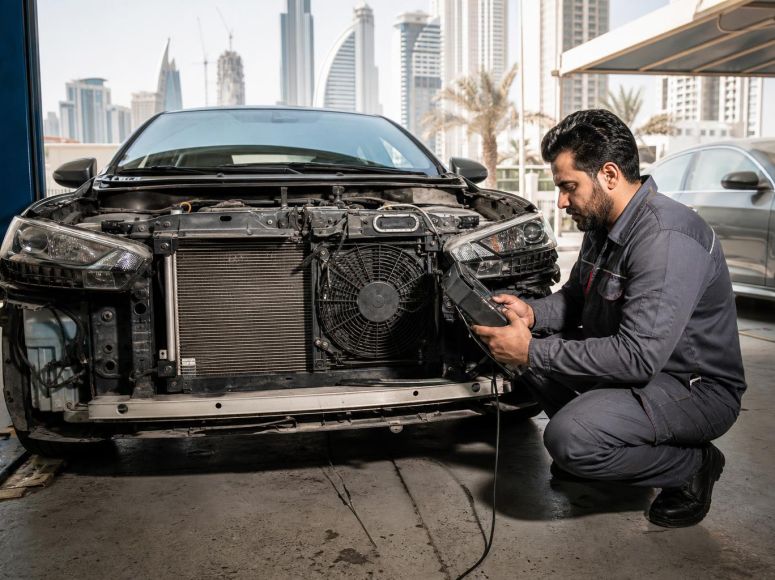
In summer traffic in Cairo, Riyadh, Dubai or Muscat, a car air-conditioning system has a far harder job than it does on an open road. One especially useful clue is this: the AC feels acceptably cold while the car is moving, then becomes weak or warm at traffic lights, in a drive-through queue or during slow city driving.
This pattern does not automatically mean the system needs refrigerant. Often, it points to an airflow problem at the condenser or a fault in the engine cooling fan system. Correct diagnosis matters: adding refrigerant to a system with the wrong charge or an unresolved fan problem can make performance worse and may lead to more expensive repairs.
Why AC performance changes between driving and idling
The condenser is the heat exchanger normally mounted at the front of the vehicle, ahead of or close to the engine radiator. It releases heat collected from the cabin into outside air. For the AC to cool properly, air must pass through the condenser.
At road speed, airflow through the front grille is naturally high. When the car is stopped, the vehicle depends largely on one or more electric cooling fans to pull or push air through the condenser and radiator. In Middle Eastern and North African heat, a marginal fan, blocked condenser or poor electrical connection can quickly become noticeable.
When heat cannot leave the condenser efficiently, refrigerant pressure rises. The system may deliver warmer air, cycle the compressor to protect itself, or reduce cooling output. In some vehicles, the engine temperature may also rise because the radiator and condenser share the same airflow path.
The most common causes of cold AC on the move and weak AC at idle
1. A cooling fan that does not run, runs slowly or works intermittently
Many modern vehicles use variable-speed electric fans. A fan may fail completely, operate only at one speed, or cut in and out as a relay, control module, wiring connection or motor begins to fail. A weak fan can be difficult to identify because it may still spin but not move enough air in extreme heat.
Possible underlying faults include a worn fan motor, blown fuse, failed relay, corroded connector, faulty fan-control module, damaged wiring, or an input problem from a coolant-temperature or AC-pressure sensor. The exact setup varies by vehicle, so diagnosis should follow the manufacturer's wiring information rather than guesswork.
2. Dust, insects, leaves or bent fins restricting the condenser
Fine desert dust, road debris and insects can collect in the narrow gap between the condenser and radiator. The front face may look reasonably clean while debris is packed deeper between the two heat exchangers. Bent fins also reduce the area available for airflow.
This is particularly relevant after frequent highway trips, desert driving, construction-area commuting or a sandstorm. A restricted condenser can cause poor AC performance at low speeds even when the refrigerant charge and compressor are healthy.
3. A dirty or obstructed front grille area
Accessories, damaged grille shutters where fitted, loose undertrays, aftermarket mesh, or a badly fitted number-plate bracket can alter airflow. This is less common than fan or condenser issues, but it is worth checking after collision repairs, front-end work or accessory installation.
4. High engine coolant temperature or a radiator airflow problem
The condenser and radiator usually work as a pair. If the radiator is externally blocked, coolant level is low, the thermostat is faulty, or the cooling system has another defect, engine heat can overwhelm the airflow package. The AC may then be reduced or switched off by the vehicle to protect the engine.
Do not treat this as an air-conditioning-only issue if the temperature gauge rises, a temperature warning appears, coolant is leaking, or steam is visible.
5. Refrigerant, compressor or pressure-control faults
A low refrigerant charge from a leak can also cause poor cooling, though it often produces inconsistent cooling in more than one driving condition. A sticking expansion valve, weak compressor, incorrect previous recharge, or a faulty pressure sensor can create similar symptoms. These faults require proper pressure, temperature and leak testing; cabin vent temperature alone cannot identify the cause.
A safe five-minute check you can do at home
These observations can help you describe the problem accurately to a workshop. They are not a substitute for diagnosis.
- Park safely outdoors. Keep hands, clothing, tools and phone well away from fans, belts and pulleys. Electric fans can start unexpectedly, including after the engine has been switched off on some cars.
- Start with a cold engine if possible. Set the AC to its coldest setting, select a moderate blower speed and use recirculation. Open the bonnet only if it can be secured safely.
- Observe the cooling fan from a safe distance. With the AC operating, many vehicles will command at least one fan to run, although fan strategy differs by model and ambient temperature. Listen for the fan and look for smooth operation without touching anything.
- Compare idle and road performance. Note whether the air is cold at 40–60 km/h but warmer after several minutes of idling. Also note whether it improves immediately when moving again.
- Watch the engine temperature indication. If it climbs above its normal position, a warning appears, or you smell coolant, stop using the AC and address the engine cooling fault promptly.
- Inspect the visible front surfaces with the engine off and cool. Look through the grille for leaves, plastic bags, heavy dust buildup, or obviously damaged fins. Do not poke fins with a screwdriver or use a high-pressure washer close to them; both can cause damage.
What to tell the workshop
A clear symptom description saves time and helps prevent unnecessary parts replacement. Tell the technician:
- whether cooling is good at speed but weak at idle;
- the outside conditions, such as midday heat, humid coastal weather or heavy traffic;
- whether the engine temperature gauge or warning light changes;
- whether the fan is silent, noisy, intermittent or apparently slow;
- whether the problem started after a sandstorm, front-end repair, overheating incident or AC service;
- if cooling improves with engine speed, movement, or after the vehicle has rested.
Ask for a diagnosis that checks fan command and actual fan speed, fuses and wiring, condenser/radiator cleanliness, engine cooling performance, refrigerant pressures and leak evidence. A reputable workshop should avoid simply adding refrigerant without checking why the system is underperforming.
What not to do
- Do not use DIY refrigerant cans blindly. The wrong refrigerant, too much refrigerant or a leak left unrepaired can damage performance and complicate professional service.
- Do not open AC refrigerant lines. Refrigerant is pressurised and should be recovered with correct equipment by a trained technician.
- Do not keep driving through an overheating warning. Turn off the AC, stop safely as soon as possible, and follow the vehicle handbook's overheating guidance.
- Do not spray high-pressure water directly into condenser fins. Gentle, controlled cleaning by an experienced technician is safer, especially where access requires removing trims or separating the radiator and condenser.
- Do not assume a cabin filter is the cause. A blocked cabin filter mainly reduces air volume from the vents. It does not normally explain air that is cold while moving but warm at idle.
Preventive care for hot, dusty climates
There is no universal cleaning interval because driving conditions differ greatly between city use, coastal humidity, unpaved roads and desert travel. Instead, include the front cooling stack in regular servicing and inspect it earlier if the vehicle frequently sees dust, sand or road debris.
- Have the condenser and radiator checked for external blockage during routine servicing.
- After desert trips or severe dust exposure, inspect the grille area and arrange careful cleaning if airflow appears restricted.
- Repair fan noise, intermittent operation and blown fan fuses promptly rather than waiting for peak summer.
- Maintain the engine cooling system with the coolant type and service procedures specified in the owner's manual.
- Use a quality workshop for AC work, particularly after a collision or when the front-end cooling package has been removed.
When the problem is urgent
Book an AC inspection soon if cooling becomes unreliable in hot weather, particularly before a long trip. Seek urgent assistance if there is an engine-overtemperature warning, steam, a strong sweet coolant smell, visible coolant loss, repeated fan-failure warnings, or a burning electrical smell. Cabin comfort is important in regional heat, but protecting the engine cooling system comes first.
Conclusion
AC that cools while driving but turns warm at idle is a valuable diagnostic clue. In MENA's high ambient temperatures, the usual focus should be on condenser airflow, cooling-fan operation and the condition of the shared radiator-condenser area before assuming the system only needs gas. A prompt, methodical inspection can restore cabin comfort, reduce strain on the cooling system and help avoid a breakdown in summer traffic.