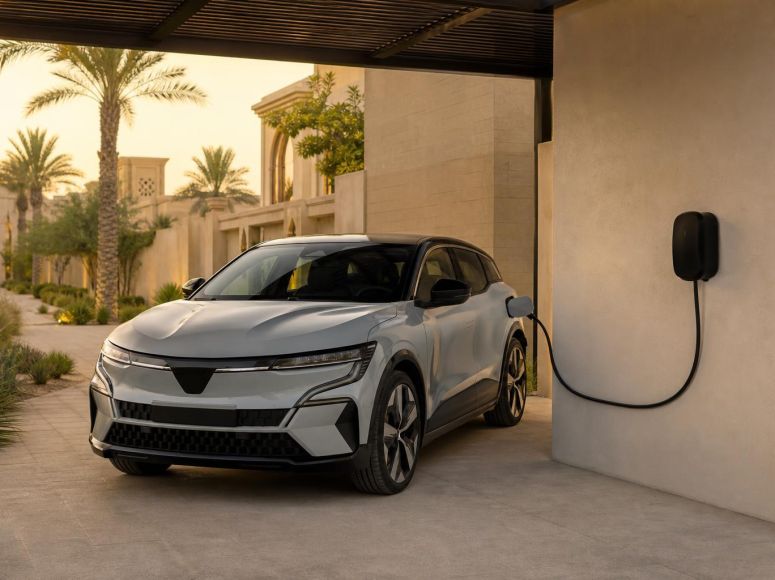
For many electric-vehicle owners in Egypt and the Gulf, home charging is the simplest way to live with an EV. The car can recharge while parked overnight, avoiding unnecessary trips to public chargers and making daily commuting more convenient. But a home charger is not simply a socket on a wall. It is a high-load electrical installation that needs to suit the property, the vehicle and the region’s demanding heat and dust.
This guide is relevant to villas, townhouses and private parking spaces across Egypt, Saudi Arabia, the UAE, Kuwait, Qatar, Bahrain and Oman. Building rules, utility requirements and available electrical supplies vary by country and development, so use it as a practical planning guide and have the final installation assessed by a qualified, locally licensed electrician.
Start with your daily driving, not the charger’s maximum rating
It is easy to focus on the largest charging number advertised, but the right home setup depends on how much energy you need to replace between drives. A driver covering a modest daily commute may be perfectly served by a lower-power AC charger running overnight. Someone who regularly returns with a low battery, drives long distances between cities or runs more than one EV may need a higher-capacity installation.
Ask these questions before choosing equipment:
- How many kilometres do you normally drive on a busy weekday?
- How long is the vehicle parked at home, especially overnight?
- Is the car usually charged from a low state of charge, or only topped up?
- Will one charging point serve one vehicle or several?
- Does the vehicle accept single-phase AC charging, three-phase AC charging, or both?
- What electrical capacity is actually available at the parking location?
Do not assume the charger’s headline output will always reach the car. The actual charging rate is limited by the lowest-rated part of the system: the car’s onboard AC charger, the EV supply equipment, the property’s electrical service and the installation design.
Understand the difference between a wallbox and an ordinary socket
A portable charging cable supplied with an EV can be useful for occasional charging, travel or emergencies. It is not automatically the best choice for routine, high-load use in a hot climate. Standard household sockets, plugs and their wiring may not be designed for many continuous hours near their maximum load, particularly if they are old, worn, poorly connected or shared with other loads.
A dedicated wallbox, also called EV supply equipment, is generally the more robust long-term solution. It communicates with the vehicle, controls the charging process and should be installed on a dedicated circuit with correctly sized cables, suitable protective devices and proper earthing. It does not convert AC electricity into the battery’s DC charging voltage; that conversion is normally handled by the vehicle’s onboard charger during AC charging.
Never use an extension lead, multi-plug adaptor or improvised cable arrangement for regular EV charging. These add connection points that can overheat, especially when exposed to sun, dust and sustained current.
Check the electrical capacity before buying equipment
An electrician should examine the property’s distribution board, main supply rating, existing loads and route to the parking space. Air conditioning is a major consideration in MENA homes. In summer, several AC units, water heaters, cooking appliances and an EV charger may operate at the same time. A charger that is acceptable on paper can still overload a poorly planned installation when the household is at peak demand.
What a proper site assessment should cover
- Supply type: whether the property has single-phase or three-phase supply, and what that means for compatible charging options.
- Spare capacity: whether the main service and distribution board can support EV charging alongside normal household demand.
- Dedicated circuit: the charger should not share a circuit with sockets, lighting, air conditioning or other major equipment.
- Cable route and size: cable sizing depends on charging current, route length, installation method, ambient temperature and local electrical rules.
- Earthing and protection: correct earthing, circuit breakers and residual-current protection are essential for shock and fire safety.
- Load management: a smart charger can reduce or pause charging when household demand approaches a set limit.
- Location: the charger and connector need a protected, accessible place that does not create a trip hazard or obstruct vehicle access.
Do not treat a breaker that trips as an inconvenience to be bypassed or replaced with a larger one. Frequent tripping is a warning that the circuit, connected load or protection design needs professional investigation.
Choose a charger suited to regional heat, dust and outdoor parking
Egypt and the GCC combine high summer temperatures with intense sun, airborne dust and, in some locations, humidity or coastal salt exposure. These conditions do not make home charging impractical, but they make charger location and equipment quality more important.
Prioritise protected placement
Where possible, install the charger under a carport, inside a well-ventilated garage or on a shaded wall. Shade protects the enclosure, cable and connector from direct solar heating. It can also make the unit more comfortable to handle. Do not enclose a charger in a sealed cabinet unless the manufacturer specifically permits it and ventilation, clearances and cable movement have been properly considered.
Look for an enclosure appropriate for the installation
For equipment installed outdoors or in semi-open parking, choose a unit rated by its manufacturer for the likely exposure to dust and water. The installation instructions matter as much as the rating: cable entries, wall mounting, gland seals and unused openings must be fitted correctly. In coastal areas, ask the installer about corrosion-resistant fixings and periodic inspection of exposed metalwork and terminals.
Protect the connector and cable
When not in use, return the connector to its holster and avoid letting it rest on the ground. Sand, mud and moisture should not be allowed into the connector contacts. Do not sharply bend, pinch, drive over or leave the cable stretched across a walkway. A cable that looks intact can still have internal damage after repeated crushing or strain.
Smart charging is especially useful when air conditioning demand is high
Smart charging is not just an app feature. In the right installation, it can help protect the property’s electrical capacity. Load-balancing systems measure or receive information about household demand and reduce the charging rate when heavy loads such as air conditioning are running. Charging can increase again when demand falls.
Scheduled charging can also be practical. If your electricity tariff or building arrangement has time-based pricing, schedule charging for eligible lower-cost periods where available. Even without time-based pricing, overnight scheduling can reduce overlap with evening cooking, laundry and peak cooling demand. Check that any schedule leaves enough time to reach the battery level needed for the next day.
For households with solar generation, ask a qualified installer how EV charging can work alongside the solar system. The answer depends on system design, inverter capabilities, local connection rules and whether the home remains grid-connected. Avoid assuming that every solar installation can safely or legally supply an EV charger without changes.
Apartment residents: solve the parking and approval question first
Apartment living can make home EV charging more complicated than villa charging. The key question is not whether a charger can physically fit near the parking bay; it is who controls the electrical supply, cable route and common areas.
Before ordering equipment, speak to the building manager, owners’ association, developer or facilities team, as applicable. You may need written approval for work in a shared parking area, confirmation of which meter will supply the charger and an agreed method for electricity billing. Rules differ substantially between developments and countries.
Useful points to clarify include:
- Whether the parking bay is privately assigned or part of a common area.
- Whether a cable route can cross common property and how it will be protected.
- Whether the charger can connect to your own meter or requires a separate metering arrangement.
- Who is allowed to carry out the installation and whether drawings or permits are required.
- Who maintains the charger, cabling and protective equipment after installation.
- Whether visitor, staff or shared-charger access is planned.
A charger installed without approval can create safety, billing and liability disputes, even if the equipment itself is high quality.
Daily charging habits that help battery life and convenience
Modern EVs have battery management systems that monitor temperature and charging, but sensible charging habits still matter. For routine daily use, follow the battery-charge guidance in your vehicle handbook or app. Many EVs allow the driver to set a daily charge limit below 100 percent; this can be useful when full range is not needed every day. Charge to the level required for your next journey, and reserve a full charge for when it is genuinely useful, such as a longer trip.
After a very hot drive, the vehicle may run cooling systems or adjust its charging rate to protect the battery. This is normal. Avoid trying to override protective behaviour. If charging repeatedly stops, the connector becomes unusually hot, warning messages appear or there is a burning smell, stop using the equipment and arrange inspection.
Simple inspection and maintenance checklist
Home chargers need less routine attention than a combustion-engine service item, but they should not be forgotten. Once a month, or more often in exposed locations, carry out a visual check:
- Look for cracks, discolouration, loose mounting or damaged seals on the charger enclosure.
- Check that the cable jacket has no cuts, flattening, exposed wiring or severe kinks.
- Inspect the connector for dust, moisture, bent contacts or signs of overheating.
- Confirm the connector holster and cable support remain secure.
- Keep the area around the charger dry and free of stored items, fuel containers and rubbish.
- Use only the cleaning method recommended by the charger manufacturer; do not pressure-wash electrical equipment.
- Arrange a qualified inspection if the charger has been flooded, struck by a vehicle, repeatedly tripped its protective device or shows visible heat damage.
A practical pre-installation checklist
- Confirm your EV’s AC charging capability and connector type.
- Estimate how much charging you need during a normal overnight parking period.
- Get a site assessment from a qualified, locally authorised electrician.
- Choose a dedicated circuit with appropriate earthing and protective devices.
- Consider load balancing if air conditioning and other large household loads may overlap with charging.
- Select a shaded, accessible location suitable for heat, dust and any moisture exposure.
- Obtain building or property-management approval before work in shared parking.
- Keep installation records, manuals and warranty information.
- Learn how to stop charging safely and recognise signs of electrical trouble.
Conclusion
A home EV charger can make electric-car ownership far easier in Egypt and the GCC, but the best setup is not automatically the fastest one. It is the one that matches the vehicle, household electrical capacity, parking arrangement and local climate. A properly assessed dedicated circuit, heat-aware placement, suitable protection and sensible load management provide a safer foundation for dependable everyday charging.