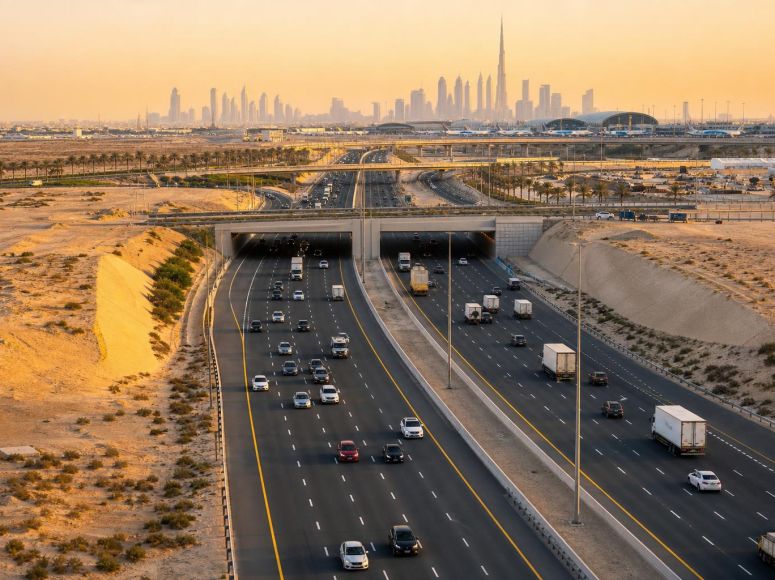
Dubai has approved the New Fourth Corridor, an approximately 80km strategic road route planned to run from Al Shanouf Road in Sharjah to Al Faya Road in Abu Dhabi. Announced on 16 September 2026, the project is intended to strengthen links between the emirates, support freight movement and relieve pressure on existing major road corridors.
The route will become the fourth strategic inter-emirate corridor after Sheikh Zayed/Al Ittihad Road, Sheikh Mohammed bin Zayed Road and Emirates Road. For motorists, fleet operators and logistics businesses, its importance lies in creating another high-capacity route across the UAE’s expanding urban, airport and industrial network.
What Dubai has approved
The project will be delivered in two phases and will connect with major infrastructure and development areas, including Al Maktoum International Airport and the Etihad Rail route. Dubai’s Roads and Transport Authority says the corridor is designed to carry through traffic—particularly trucks—away from more urban areas.
- Total planned length: approximately 80km
- Major structures: 72 bridges, 17 tunnels and 45 stormwater-drainage culverts
- Road capacity: up to 24,000 vehicles per hour in both directions on each phase
- Key objective: better inter-emirate connectivity and freight movement while easing traffic on existing corridors
Phase one: Sharjah to Dubai–Al Ain Road
The first phase will cover around 30km from Al Shanouf Road in Sharjah to Dubai–Al Ain Road. It has an announced cost of approximately AED 3.5 billion.
According to the RTA, this section will provide a 12-lane through corridor across both directions. It is expected to reduce a specified journey from 35 minutes to 14 minutes, a reduction of 60%, and serve around 600,000 people.
Works planned for phase one
- About 55 lane-kilometres of at-grade roads
- Approximately 2.5km of tunnels
- Approximately 21km of bridges and ramps
- Widening Dubai–Al Ain Road from three to four lanes in each direction between Emirates Road and Lehbab Road
- Upgrades to four major intersections
Phase two: Dubai–Al Ain Road to Abu Dhabi
The second phase is planned to extend roughly 50km from Dubai–Al Ain Road to Al Faya Road in Abu Dhabi. It is also planned as a 12-lane route across both directions, with capacity of up to 24,000 vehicles per hour.
The RTA projects that this phase will cut a specified journey from 50 minutes to 24 minutes, a reduction of 52%, and serve around 3.1 million people. Planned works include around 190 lane-kilometres of at-grade roads, 3.5km of tunnels, and 157km of bridges and ramps.
Why this matters to UAE drivers
This is an approval for a future infrastructure project, rather than an immediate new road opening. The official announcement did not set construction-start or completion dates. However, the scale of the project makes it significant for daily motorists, commercial fleets and businesses operating between Sharjah, Dubai and Abu Dhabi.
For private-car drivers, a new strategic route could provide more options as residential, logistics and airport-related development expands. For commercial operators, the proposed focus on diverting through traffic and trucks could improve the reliability of longer cross-emirate journeys. Its planned connections to Al Maktoum International Airport and Etihad Rail also underline the corridor’s role in the UAE’s wider transport and logistics network.
Drivers should note that the announced time savings and capacity figures are projected outcomes from the RTA’s plan, not current road conditions. Further details on construction scheduling, traffic diversions and eventual access points will be important as the project progresses.