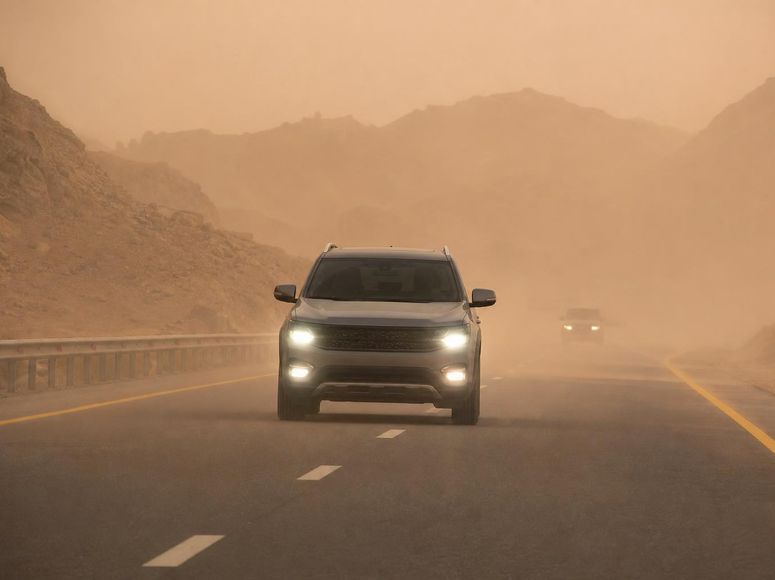
Dust and sand storms can turn a familiar road into a low-visibility hazard within minutes. They affect urban motorways, desert routes and open rural roads across the Gulf, Egypt, Jordan and North Africa, particularly where strong winds can lift fine dust from exposed ground. The main danger is not simply sand on the car: it is the sudden loss of visibility, unpredictable traffic behaviour and reduced ability to see lane markings, hazards and stopped vehicles.
A safe response depends on recognising the conditions early, reducing risk before visibility becomes severe, and avoiding the common reactions that create secondary collisions. This guide is intended for normal road driving. If authorities issue travel warnings or close roads, postponing the journey is always the safest choice.
Before setting off: make the car ready for dusty conditions
Preparation cannot make it safe to drive through a severe dust storm, but it can improve your margin of safety when conditions deteriorate unexpectedly.
- Check the weather and road advisories: Pay particular attention before long intercity journeys, desert-edge routes and exposed highways. Wind and dust warnings can matter more than a forecast that merely says “sunny.”
- Keep the windscreen clean inside and out: A dusty windscreen scatters light and becomes much harder to see through in low contrast. Clean the inside surface as well; haze builds up there too.
- Inspect wiper blades and washer fluid: Use washer fluid suitable for your climate and keep the reservoir topped up. Never run dry wipers over a heavily sand-coated screen, as grit can scratch the glass and damage the rubber blades.
- Check all exterior lights: Headlights, tail lights, brake lights and indicators must be clean and working. In dust, being seen from behind can be as important as seeing ahead.
- Maintain tyres correctly: Use the vehicle manufacturer’s recommended road pressures for normal driving. Do not lower tyre pressure for a public-road dust storm; lower pressures are a specialised off-road technique and can make road handling less precise.
- Carry basic supplies: Water, a charged phone, a charging cable or power bank, and any necessary medication are sensible additions for long trips. Keep emergency items secured so they do not become projectiles in a sudden stop.
Recognise when conditions are becoming unsafe
A dust storm does not always look like a dramatic wall of sand. Early signs can include a yellow, orange or grey haze in the distance, rapidly fading contrast, dust moving across the road in sheets, and vehicles ahead becoming difficult to distinguish.
If visibility is already declining, do not try to “beat” the storm by driving faster. A short delay at a safe location is far preferable to reaching a section of road where you cannot see far enough to stop safely.
What to do when dust reduces visibility while you are driving
- Ease off the accelerator smoothly. Avoid abrupt braking or sharp steering inputs. Sudden actions can surprise drivers following you and may unsettle the vehicle if loose sand has accumulated on the road.
- Increase following distance dramatically. The normal gap is not enough when visibility and braking confidence are reduced. Leave enough room to stop if traffic ahead slows or disappears into the haze.
- Turn on dipped-beam headlights. This helps other road users identify your vehicle. Avoid high beams: their light can reflect from airborne dust and reduce your own visibility.
- Keep your attention on road position. Follow lane markings where visible, but do not fixate on the vehicle directly ahead. Watch for brake lights, road edges and changing traffic flow.
- Close windows and use recirculation. Set the air conditioning to recirculate cabin air where possible. This reduces the amount of dust drawn into the cabin. If the windscreen begins to mist, use the demist setting as needed, while keeping windows closed if outside dust is severe.
- Do not use cruise control. You need immediate and precise control of speed as sight distance changes.
- Stay calm and avoid unnecessary lane changes. Lane changes are risky when mirrors, blind spots and lane markings are obscured. Signal early if a move is unavoidable.
If visibility becomes near-zero: do not stop in a live lane
When you can no longer see a safe stopping distance, the aim is to get out of moving traffic without creating a hidden obstacle for vehicles behind. This is often the most difficult part of driving in a dust storm.
Look for a genuinely safe refuge, such as a service station, rest area, designated parking area or a road well away from through traffic. Reduce speed progressively and indicate early. Do not make a sudden turn onto an unpaved shoulder simply because it is visible; soft sand, drainage channels, roadside obstacles and drop-offs can be hidden by dust.
If there is no safe place to leave the road, continue at the lowest safe speed until one is available, keeping your lights on. Avoid stopping in the travel lane. A stationary vehicle in poor visibility can be struck by traffic approaching from behind, especially on fast multi-lane roads.
Once safely parked away from traffic, keep seat belts fastened, lock the doors and wait for visibility to improve. Follow official emergency instructions if issued. Before rejoining the road, clear your windows and mirrors, check for approaching vehicles carefully, and build speed only when you have a clear view.
Lights, hazard flashers and fog lights: use them carefully
Lighting choices can affect whether other drivers understand what your vehicle is doing.
- Dipped-beam headlights: Use them when visibility is reduced. They make the front and rear of the vehicle more conspicuous without the glare of high beams.
- Rear fog light: If fitted, it can help vehicles behind identify you in very poor visibility. Switch it off once conditions improve, because its intense brightness can distract following drivers in clearer conditions.
- Hazard warning lights: Their use depends on local traffic rules and the situation. They may be appropriate when your vehicle is stopped safely or is experiencing an immediate hazard, but they can obscure indicators and confuse other drivers if used while moving. Follow local requirements and avoid relying on them as a substitute for safe speed, spacing and proper lighting.
Common mistakes that make dust-storm driving more dangerous
Following tail lights too closely
Using the car ahead as a guide feels reassuring, but it leaves no reaction time if that driver brakes, swerves or stops. Keep a large gap and do not assume the driver ahead can see better than you can.
Braking hard after hitting a patch of sand
Loose sand can reduce tyre grip, especially where it has blown across a bend, slip road or roundabout approach. Lift off the accelerator, keep the steering smooth and brake progressively if required. Electronic stability and anti-lock braking systems assist the driver, but they cannot create grip where the road surface has none.
Using high beams
High beams can make airborne dust appear as a bright wall, reducing contrast further. Dipped beams are normally the better choice.
Opening windows to clear the windscreen
Opening a window may bring a burst of dust into the cabin and can make visibility, breathing comfort and interior cleaning much worse. Use the ventilation controls and demister instead.
Driving again as soon as the air looks clearer
Visibility can improve unevenly, and dust may settle on the road in slippery patches. Resume normal speed gradually, keep extra distance, and remain alert for stopped or damaged vehicles.
After the storm: inspect the car before returning to normal use
Fine dust reaches areas that are easy to overlook. A quick inspection can prevent poor visibility, unpleasant cabin air and avoidable wear.
- Clean glass, mirrors, lights and number plates: Use plenty of water or a suitable wash method to rinse loose grit before wiping. Dry wiping can drag abrasive particles across paint and glass.
- Check the wiper blades: Remove accumulated grit gently. Replace blades that chatter, smear or have torn edges.
- Inspect the air filter and cabin filter when due: Dusty conditions can load filters more quickly than ordinary urban use. A restricted engine air filter may affect performance, while a clogged cabin filter can weaken airflow and leave the interior dusty. Follow the vehicle’s service schedule, but ask for an earlier inspection if air-conditioning airflow has noticeably reduced or dust has entered the cabin.
- Listen for brake noise: Sand around brake components can cause temporary noise. Persistent grinding, pulling, vibration or a warning light needs professional inspection.
- Rinse the exterior and underbody where practical: Pay attention to wheel arches, door shuts and the area around the windscreen cowl. Do not direct high-pressure water at close range into electrical connectors, seals or engine-bay openings.
- Check the engine bay visually: With the engine off and cool, look for unusual accumulations of dust around accessible seals and intake areas. Do not use compressed air indiscriminately, as it can force grit deeper into components.
When to delay the journey
Delay is the right decision when a warning applies to your planned route, when visibility is already poor at departure, or when the trip is not essential. This is especially important for long journeys between cities, routes with heavy truck traffic, and roads with limited safe stopping places.
If you must travel for an urgent reason, tell someone your route and expected arrival time, keep your fuel level comfortably above reserve, and use official weather, road and emergency-information sources for the country where you are travelling. Procedures and warning systems differ across MENA markets, so rely on local authorities rather than assumptions from another country.
Conclusion
The safest dust-storm strategy is simple: avoid the journey where possible, slow down early when conditions change, use dipped headlights, leave far more space than usual, and seek a safe place off the road before visibility becomes critical. Afterward, clean the vehicle properly and check filters, wipers, lights and brakes. In the dusty climates common across the Middle East and North Africa, these habits protect both the car and the people inside it.