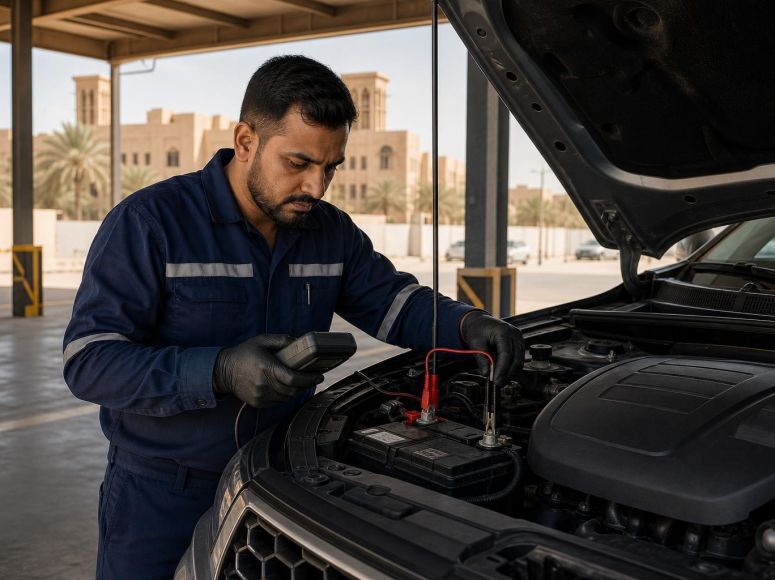
A car that starts normally in the morning can refuse to crank after an afternoon parked in intense heat. Across the Gulf, Egypt, Jordan and much of North Africa, the conventional 12-volt battery works harder than many owners realise. High under-bonnet temperatures accelerate battery ageing, while frequent air-conditioning use, urban traffic and short journeys can leave it less able to recover its charge.
Most no-start problems give warning signs before the battery fails completely. A simple seasonal inspection and a proper battery test can help you replace a weak unit on your schedule rather than waiting for a roadside recovery in summer.
Why hot weather is tough on car batteries
Heat speeds up the chemical reactions inside a lead-acid battery. That may sound helpful, but prolonged high temperatures can increase water loss and accelerate deterioration of the battery’s internal components. Vibration, poor battery mounting and corrosion at the terminals can further reduce reliability.
The effect is often delayed. A battery stressed through a long summer may seem acceptable until cooler weather, a period of parking, or one demanding start exposes its reduced capacity. This is why battery failures are common without an obvious single cause.
Heat is not the only local factor. The following habits and conditions can increase the load on a 12-volt battery:
- Long periods parked outdoors in direct sun.
- Heavy use of air conditioning, blower motors, lights and infotainment while idling or driving slowly.
- Repeated short trips that do not give the charging system much time to recharge the battery.
- Dust, humidity and coastal salt air contaminating terminals and connections.
- Accessories such as dash cameras, trackers, aftermarket audio equipment or phone chargers drawing power while the vehicle is parked.
- Leaving a vehicle unused for weeks during travel or seasonal absence.
Warning signs a battery needs attention
Do not assume every starting issue is caused by the battery; starter-motor, alternator, wiring and key-system faults can produce similar symptoms. Still, these signs justify a battery and charging-system check soon:
- The engine cranks noticeably slower than usual, especially after the car has sat overnight.
- The starter clicks repeatedly but the engine does not turn over.
- Headlamps dim significantly while cranking.
- The battery warning lamp stays on after the engine starts. This more often points to a charging-system fault than a weak battery.
- Electrical settings reset, the clock loses time, or the infotainment system restarts unexpectedly.
- Start-stop stops operating consistently, although its availability also depends on temperature, cabin cooling demand and other conditions.
- A swollen battery case, a sulphur or “rotten egg” smell, visible leakage, or unusually hot battery casing.
Safety first: a swollen, leaking or strongly smelling battery should not be ignored or jump-started casually. Keep sparks and flames away, avoid touching leaked material, and arrange professional assistance.
Make battery inspection part of pre-summer maintenance
Late spring is a sensible time for drivers in very hot parts of MENA to have the battery tested, before peak summer temperatures arrive. In milder North African climates, a check before the hottest season and before a long road trip is still worthwhile.
1. Check the battery is secure
With the engine switched off, inspect the battery hold-down bracket. The battery should be firmly restrained and should not move in its tray. Loose mounting exposes it to vibration that can damage internal plates and terminals. Do not overtighten or modify the bracket; have a workshop correct missing or damaged hardware.
2. Look at the case, tray and vents
Look for cracks, bulging sides, leaks and signs of electrolyte residue. Check that the tray is not badly corroded and that any original ventilation arrangement is intact. Modern maintenance-free batteries normally should not be opened or topped up by the owner. Follow the vehicle and battery manufacturer’s instructions rather than removing caps or adding water.
3. Inspect the terminals and cables
Blue-green or white powder around terminals can interfere with current flow. Ensure the terminal clamps are tight, with no damaged cable insulation or loose earth connection. If cleaning is needed, switch off the vehicle and follow the owner’s manual. A technician can safely disconnect, clean, protect and refit the connections if you are uncertain.
In coastal areas, including parts of the UAE, Oman, Saudi Arabia, Bahrain, Kuwait, Qatar, Egypt, Morocco and Tunisia, humid salty air can make regular terminal inspection especially useful.
4. Get a proper test, not only a voltage reading
A resting voltage check can be informative, but it does not reliably show how a battery behaves under starting load. Ask for a battery conductance or load test and, when appropriate, a charging-system test. A workshop can compare measured capacity with the battery’s rated specification and check whether the alternator is charging correctly.
Testing matters because fitting a new battery will not solve a faulty alternator, a poor connection or an excessive parasitic drain. Equally, an alternator can appear healthy while an ageing battery has little remaining reserve.
Choose the correct replacement battery
When replacement is recommended, do not select a battery only because it physically fits or has the lowest price. Use the specification in the owner’s manual, the original battery label, or a reputable parts catalogue matched to the vehicle identification details.
Key points to match include:
- Battery technology: conventional flooded, EFB or AGM. Vehicles with start-stop systems often require EFB or AGM batteries. Downgrading the technology can shorten service life and affect start-stop operation.
- Capacity and starting rating: use the manufacturer-specified range. More is not automatically better if the battery is incompatible or not fully supported by the vehicle’s charging strategy.
- Case size and terminal layout: the battery must sit correctly in the tray, with cables reaching without strain and the positive and negative terminals in the correct positions.
- Fresh stock: check the manufacturing date code where available. A battery stored for a long time in hot conditions may have lost useful service life before installation.
Some newer vehicles use a battery monitoring sensor and may need the replacement battery registered or reset through diagnostic equipment. This allows the charging system to manage the new battery correctly. Ask the installer to check the vehicle’s procedure, particularly on cars with start-stop, energy-management systems or multiple batteries.
Everyday habits that help a battery last
Drive it long enough to recharge
Short city trips may not replace the energy used by starting the engine and running electrical equipment. Where practical, combine errands or take the vehicle for a normal-length drive periodically. Idling is not an efficient substitute for driving and creates unnecessary heat and fuel use.
Reduce unnecessary parking drain
Use accessories with care when the engine is off. A hardwired dash camera, tracker, aftermarket amplifier or charging device can drain a marginal battery over time. If the vehicle develops repeated flat-battery symptoms, ask an auto electrician to measure parasitic draw rather than repeatedly jump-starting it.
Prepare before leaving the car unused
If you will be away for several weeks, consult the owner’s manual. Depending on the vehicle, a compatible smart battery maintainer may be appropriate where secure mains power is available. Do not use a random charger or extension lead outdoors in heat or rain. Some vehicles have specific storage procedures, and disconnecting the battery may erase settings or cause issues with alarms and electronic systems.
Keep heat exposure in perspective
Shade or covered parking reduces cabin and under-bonnet heat after parking, but it cannot eliminate summer stress. A windshield shade helps cabin comfort, while reliable battery care still depends on testing, sound connections and correct charging.
What to do if the car will not start
- Make sure the gear selector is in Park or Neutral, the parking brake is applied, and the vehicle is in a safe, ventilated location.
- Check for obvious warning signs such as a swollen or leaking battery. If present, call for assistance rather than attempting a jump-start.
- If the battery appears sound, use only a suitable jump pack or follow the vehicle manual’s jump-start points and sequence. Incorrect connections can damage electronics or cause injury.
- Once the engine starts, do not assume the problem is fixed. Arrange a battery and charging-system test as soon as possible.
- If the battery warning light remains illuminated while driving, minimise electrical load where safe and seek prompt professional help; the charging system may not be working.
Battery care for hybrids and EVs
Hybrid and electric vehicles also have a low-voltage 12-volt battery, even though propulsion comes from a high-voltage battery pack. A weak 12-volt battery can prevent the vehicle from powering up or closing its high-voltage contactors. The inspection principles above still apply, but never touch orange high-voltage cables or attempt repairs to the traction battery. Use the model-specific procedures in the owner’s manual and a qualified workshop for any high-voltage system work.
Conclusion
In MENA heat, a car battery is a wear item that deserves attention before it leaves you stranded. Inspect the case and terminals, keep the battery properly secured, have it professionally tested ahead of summer and fit the correct replacement type when its condition is poor. A small preventive check is far easier than discovering a no-start in a hot car park or before a long journey.