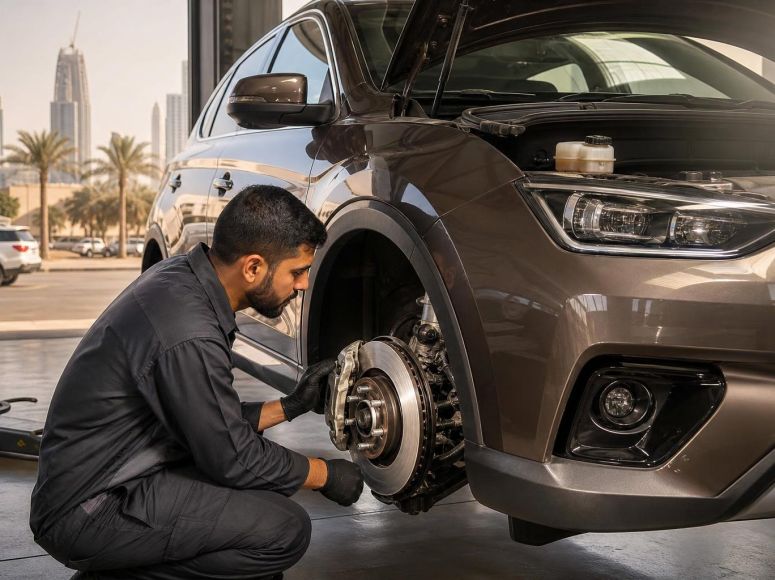
Brakes are easy to overlook until they become noisy, weak or unpredictable. In the Middle East and North Africa, high ambient temperatures, congested urban driving, long motorway journeys and dusty conditions can place extra demands on pads, discs and brake fluid. The goal is not to service brakes more often without reason; it is to inspect them properly, use the correct fluids and parts, and act early when braking behaviour changes.
This guide applies broadly to drivers in Egypt, the GCC, Jordan and North Africa. Always treat your vehicle handbook and the maintenance schedule from the manufacturer as the final authority, particularly for brake-fluid specification and service intervals.
Why local driving conditions matter to brake maintenance
A brake system turns a vehicle's motion into heat. Every firm stop raises the temperature of the pads and discs, while the hydraulic system transfers pedal force to the brake calipers. Modern braking systems are designed for demanding conditions, but heat and contamination reveal neglected components sooner.
- High summer temperatures: Hot weather starts the brake system at a higher temperature. Repeated hard stops, mountain descents or towing can add considerably more heat.
- Urban stop-start traffic: Busy roads in cities such as Cairo, Riyadh, Jeddah, Dubai, Abu Dhabi, Kuwait City and Doha can wear pads and discs faster than steady motorway use.
- Dust and sand: Fine dust can settle around calipers and wheels. Grit trapped between a pad and disc may contribute to noise or scoring, while dust can also hide a fluid leak or uneven pad wear during a quick visual check.
- Long-distance travel: A heavily loaded car on a summer road trip has more momentum to control. Brake condition matters even more when the route includes steep gradients or frequent high-speed slowing.
Brake fluid: the maintenance item many owners miss
Brake fluid is not simply a hydraulic liquid that lasts forever. Most passenger vehicles use glycol-based brake fluid, commonly specified as DOT 3, DOT 4 or DOT 5.1. These fluids are hygroscopic, meaning they gradually absorb moisture from the air over time. Moisture lowers the fluid's boiling point and can contribute to internal corrosion in the hydraulic system.
Under severe braking, overheated or moisture-contaminated fluid may boil. This can create vapour in the hydraulic circuit, resulting in a soft pedal and reduced braking response. This is a safety-critical situation.
Follow the specified interval, not the fluid colour alone
Check your handbook for the correct brake-fluid type and replacement interval. Some manufacturers specify a time-based interval, while others incorporate inspections into their service schedule. A car that covers low annual mileage can still need fluid replacement because moisture absorption is driven by time as well as use.
Fluid colour is not a reliable pass-or-fail test. Fresh fluid may darken with age, but appearance alone cannot confirm its water content or condition. A reputable workshop can use appropriate testing equipment and, where specified, replace the fluid by flushing the system.
Use only the fluid your vehicle specifies
Do not choose brake fluid by price or by a higher DOT number alone. Use the exact specification stated on the reservoir cap and in the owner's manual. DOT 3, DOT 4 and DOT 5.1 are generally glycol-based, but the vehicle maker's requirement still takes priority. DOT 5 silicone fluid is different and must not be mixed with glycol-based brake fluids.
If the level is low, do not repeatedly top it up without finding out why. A falling level may result from normal pad wear, but it can also indicate a leak. Have the pads and hydraulic system checked before adding fluid.
Signs your brakes need attention
Book an inspection promptly if you notice any of the following. Do not wait for the next routine service if braking performance has changed.
- Spongy, unusually long or sinking brake pedal: This can indicate air, fluid problems or a hydraulic fault.
- Vehicle pulling under braking: Uneven braking can be caused by a sticking caliper, contaminated friction material, tyre issues or other faults.
- Steering-wheel shake or pedal pulsation: This may be related to disc condition, uneven friction deposits, suspension wear or wheel-related issues. Proper diagnosis is needed.
- Grinding, repeated scraping or harsh metal-on-metal noise: Stop driving when safe and arrange an urgent inspection. Pads may be worn beyond their friction material.
- Burning smell, smoke or a wheel that is unusually hot: A seized caliper or parking-brake fault may be causing a brake to drag. Stop safely and let the vehicle cool; do not pour water over hot brake components.
- Brake warning light or ABS warning light: Consult the handbook and have the system diagnosed. A red brake warning light can indicate a serious fault.
- Visible wetness around a wheel, brake hose, caliper or master cylinder: Treat suspected brake-fluid leakage as urgent.
A simple monthly visual check
You do not need to dismantle the brakes at home, but a short monthly check can help you spot trouble early. Park on level ground, switch off the engine and allow hot components to cool before inspecting.
- Check the brake-fluid reservoir level. The level should sit between the marked minimum and maximum lines. Use a clean torch to inspect it; do not open the cap unless necessary.
- Look through the wheel spokes where possible. Compare the visible outer brake pads from side to side. Uneven wear, a very thin pad, a heavily grooved disc or fluid wetness deserves professional attention.
- Look for leaks beneath the vehicle. Any unexplained fluid near a wheel or under the engine bay should be assessed. Do not assume it is harmless water from the air conditioner.
- Pay attention on the next drive. With traffic conditions permitting, note whether the pedal feels consistent and whether the car tracks straight during normal, gentle braking.
- Check tyre condition and pressure. Tyres provide the grip that lets brakes work effectively. A worn or incorrectly inflated tyre can increase stopping distance and make braking feel unstable.
What a proper brake inspection should include
A workshop inspection should be more than a quick glance at the pads. Ask for a clear explanation of what was measured or observed. Depending on the vehicle and its condition, a thorough check can include:
- Pad thickness and wear pattern on both inner and outer pads;
- Disc condition and thickness measured against the manufacturer's minimum specification;
- Caliper slide pins, pistons, boots and mounting hardware for free movement and damage;
- Flexible hoses and metal brake lines for cracks, corrosion, swelling or leaks;
- Brake-fluid condition and the manufacturer's scheduled replacement requirement;
- Parking brake operation, including electronic parking-brake service mode where required;
- ABS/ESC warning lights and fault codes if a warning is present;
- Wheel bearings, suspension parts and tyres where symptoms such as vibration or pulling need diagnosis.
When pads are replaced, inspect the discs at the same time. Fitting new pads onto badly worn, cracked, deeply scored or below-minimum-thickness discs can compromise results and shorten the life of the new pads.
Driving habits that protect brakes on hot roads
Maintenance is essential, but driving technique also controls brake temperature and wear.
- Leave a larger following gap. Anticipating traffic reduces abrupt braking and repeated heavy stops.
- Use engine braking on long descents. Select an appropriate lower gear or use the vehicle's manual, low or hill-descent functions where fitted. This helps avoid continuously riding the brakes.
- Avoid left-foot braking in automatic cars unless specifically trained and required. Resting a foot on the pedal can create drag and overheating.
- Do not hold a vehicle on a slope using the accelerator. Use the brake pedal, Auto Hold or the parking brake as intended.
- Allow hot brakes to cool naturally. After a demanding descent or repeated hard stops, avoid washing the wheels or driving through deep water immediately. A rapid temperature change can be hard on hot components.
- Reduce speed before standing water or loose-surface areas. Wet, sandy or dusty roads reduce tyre grip, regardless of how new the brakes are.
After dusty travel or desert use
Following travel on unpaved tracks, desert access roads or very dusty routes, rinse loose dirt from the wheels and wheel arches using moderate water pressure. Avoid directing high-pressure water closely at seals, electrical connectors and hot brake components. A normal road test afterwards can clear light surface rust and moisture from discs, but persistent grinding, pulling, vibration or a warning light requires inspection.
If the vehicle has been driven through soft sand, been recovered, or suffered an impact underneath, ask a technician to inspect brake lines, ABS wiring and underbody protection as part of the post-trip check.
When to stop driving
Do not continue driving simply because the car can still move. Arrange recovery or urgent professional assistance if the brake pedal goes close to the floor, braking power is clearly reduced, a brake warning light is illuminated with poor pedal feel, brake fluid is leaking, or a wheel is smoking or extremely hot. These symptoms can develop into a complete loss of safe braking.
Conclusion
Reliable brakes in MENA conditions come down to routine inspection, correct brake fluid, quality parts and calm driving habits. Follow the manufacturer's service schedule, react quickly to changes in pedal feel or braking behaviour, and do not let dust or a quiet warning noise postpone a proper check. In high heat and dense traffic, a well-maintained braking system is one of the most important safety investments you can make in your car.